
Cheapest Energy Supplier UK: A Simple Guide to Comparing Energy Prices
Finding the cheapest energy deal can feel more complicated than it should be.
There are unit rates, standing charges, fixed and variable tariffs, exit fees, payment methods — and then there are all the headlines telling you which energy deal is supposedly the cheapest.
But the cheapest deal for one household might not be the cheapest for another.
The best way to find out what could actually save you money is to compare deals using your own household's energy usage.
This simple guide explains what to look for and how to compare energy deals without getting lost in the jargon.
Start With Your Most Recent Energy Bill
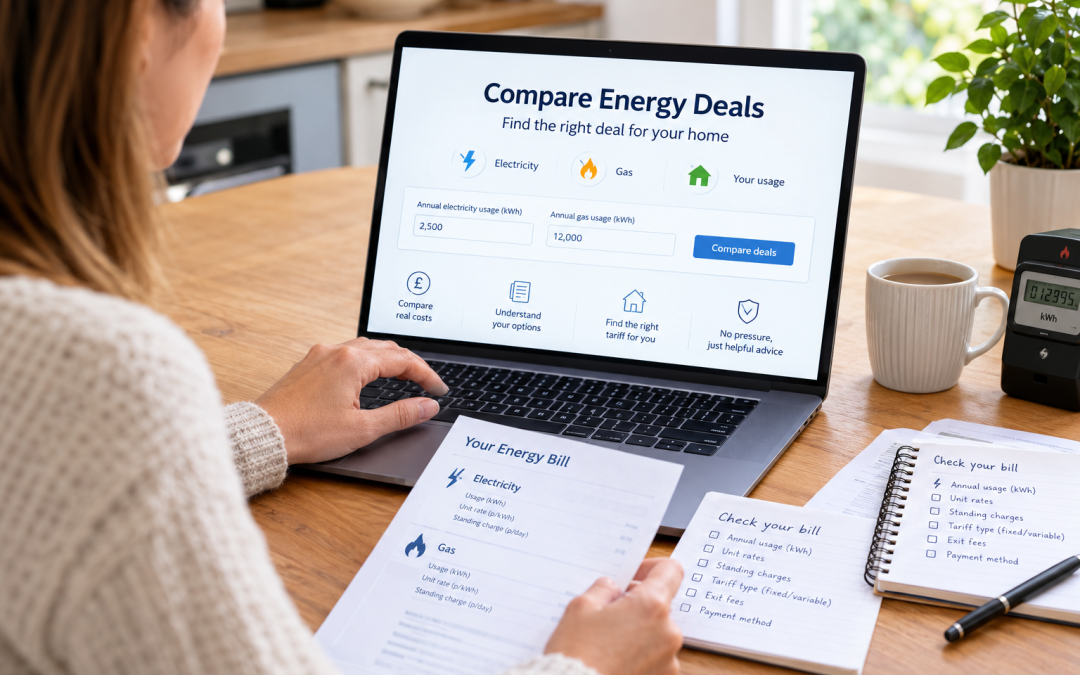
Before comparing anything, find your latest gas and electricity bill or annual statement.
You'll ideally need:
- Your annual electricity usage in kWh
- Your annual gas usage in kWh
- Your current electricity unit rate
- Your current gas unit rate
- Your electricity standing charge
- Your gas standing charge
- Your current tariff type
- Your payment method
- Any exit fee that applies
Don't worry if the numbers look complicated. These are the figures that allow you to make a much more meaningful comparison than simply looking at a headline saying "cheapest energy tariff".
Why your usage matters
Imagine two households are offered exactly the same energy tariff.
One uses relatively little electricity and gas, while the other has a larger home and much higher consumption.
They could end up paying very different amounts over the year.
That's why comparing the estimated annual cost based on your own usage is usually much more useful than comparing the unit rate alone.
Unit Rates vs Standing Charges: What's the Difference?
These are two of the most important figures to understand.
Unit rate
The unit rate is what you pay for the energy you actually use.
It is normally shown as:
- pence per kWh (p/kWh)
For example, if your electricity unit rate is 30p per kWh and you use 3,000 kWh during a year, the energy usage element would be based on that consumption.
Standing charge
The standing charge is a fixed daily charge for having your energy supply.
You pay it regardless of how much energy you use.
It is normally shown as:
- pence per day
This is important because a tariff with a slightly cheaper unit rate isn't automatically cheaper overall if it has a significantly higher standing charge.
The key is to look at the total estimated annual cost, not just one number.
Fixed vs Variable Energy Tariffs
You'll also need to understand whether you're comparing a fixed or variable tariff.
Fixed tariffs
A fixed tariff generally means the unit rates you're offered are fixed for an agreed period.
This can provide greater certainty about your rates during that period.
However, check the terms carefully. Fixed tariffs can include exit fees if you leave before the end of the contract.
Variable tariffs
With a variable tariff, the rates can change over time according to the terms of the tariff.
There may be more flexibility, but your future energy costs can be less predictable.
Neither option is automatically cheaper for every household.
The important thing is to compare the actual tariff terms and estimated cost against your current deal.
Don't Forget Exit Fees
If you're already on a fixed tariff, check whether there's an exit fee before switching.
An exit fee is a charge that may apply if you leave your current tariff before the end of the agreed period.
For example, you might find a new tariff that looks cheaper but discover that leaving your existing deal would cost you money.
That doesn't necessarily mean switching isn't worthwhile — it simply means the exit fee needs to be included when working out the potential saving.
Always check the tariff's terms before switching.
Your Payment Method Can Affect the Deal
The way you pay for your energy can also affect the tariffs available to you and the prices you're offered.
Depending on the supplier and tariff, you may see different options for things such as:
- Direct Debit
- Paying by card
- Prepayment
- Other payment arrangements
When comparing deals, make sure you're comparing tariffs on a like-for-like basis.
A deal might look cheaper based on one payment method but not be suitable for the way you want to manage your bills.
A Quick Energy Comparison Checklist
Before you start comparing, grab your latest bill and work through this checklist:
Your household's figures
☐ Annual electricity usage (kWh)
☐ Annual gas usage (kWh)
☐ Electricity unit rate
☐ Gas unit rate
☐ Electricity standing charge
☐ Gas standing charge
Your current tariff
☐ Fixed or variable?
☐ When does the tariff end?
☐ Are there exit fees?
☐ How do you currently pay?
When comparing new deals
☐ Check the estimated annual cost
☐ Compare both unit rates and standing charges
☐ Check the tariff length
☐ Check for exit fees
☐ Check payment requirements
☐ Make sure the estimated usage is based on your household's actual consumption
This takes a little longer than simply searching for "cheapest energy", but it can give you a much clearer picture of what a deal could cost for your home.
Low Energy Users: Don't Ignore Standing Charges
If your household uses relatively little energy, standing charges can make up a larger proportion of your overall bill.
That's because you pay the standing charge every day, regardless of how much energy you use.
So if you're a low user, don't concentrate entirely on finding the lowest unit rate.
Compare the complete annual cost, including standing charges.
High Energy Users: Unit Rates Become More Important
If your household uses a lot of gas or electricity, the unit rate can have a bigger impact because you're paying for more kWh.
This could include households with:
- Larger homes
- Higher occupancy
- Electric heating
- Electric vehicles
- Regularly used appliances
- Other energy-intensive equipment
Again, there's no single tariff that's automatically cheapest for every high-use household.
Your own annual consumption is what makes the comparison meaningful.
Should You Get Gas and Electricity Together?
This is where dual fuel comes into the picture.
A dual-fuel tariff means getting both gas and electricity from the same supplier.
It can be convenient because you have one supplier and potentially one place to manage your energy account.
However, don't assume dual fuel is automatically the cheapest option.
Sometimes it can be worth comparing:
Gas + electricity from one supplier
against
Gas and electricity from separate suppliers
If separate deals give you a lower combined annual cost, the potential saving may outweigh the convenience of having everything together.
The easiest approach is to compare the total cost for both fuels, rather than assuming dual fuel is better.
Don't Be Distracted by the "Cheapest" Headline
Energy prices and tariffs change, and the deal that gets attention in a headline isn't necessarily the right one for your household.
Your home could have completely different:
- Gas usage
- Electricity usage
- Payment preferences
- Tariff requirements
- Contract dates
- Exit fees
That's why the most useful question isn't:
"What's the cheapest energy tariff?"
It's:
"What's the cheapest suitable tariff for my household based on how much energy I actually use?"
That small change in approach can make comparing energy deals much easier.
Ready to Compare?
You don't need to be an energy expert to compare your options.
Take your latest bill, find your annual gas and electricity usage, and use those figures when comparing available tariffs.
If you'd like a simple way to compare your options, Energy Deal UK can help you look at energy deals based on your household's requirements.
Compare energy deals with Energy Deal UK
Visit Energy Deal UK and see what options may be available for your home.
There's no need to rely on headlines or guess which tariff might be cheapest — compare based on your own energy usage and make an informed choice that's right for your household.