
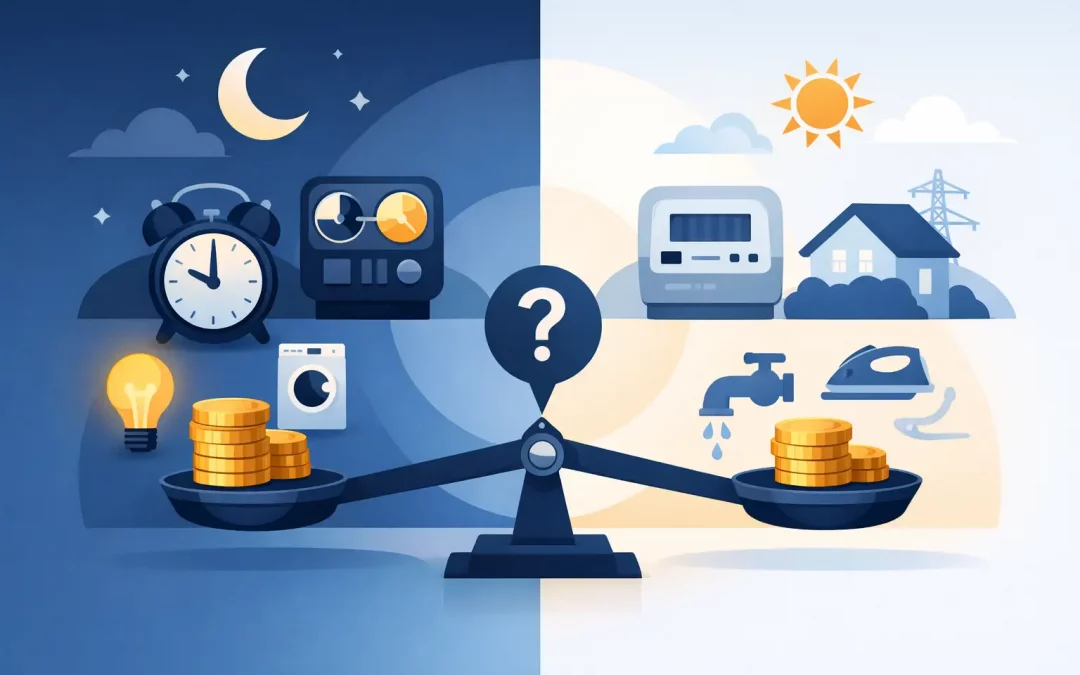
If your electricity bill feels higher than it should, the choice between economy 7 vs standard tariff can make a real difference. The right option depends less on the tariff name and more on when your home uses electricity. Get that part wrong and you could end up paying more, even if the rates look competitive at first glance.
For many households, this is where things get confusing. Economy 7 sounds like a money-saving deal because it offers cheaper electricity overnight. A standard tariff sounds simpler because you pay one rate all day. Neither is automatically better. It comes down to your routine, your heating setup, and whether you can shift a meaningful chunk of your usage into off-peak hours.
Economy 7 vs standard tariff: the key difference
A standard electricity tariff charges one unit rate for electricity, no matter what time of day you use it. That makes it easy to understand and easy to budget for. If you boil the kettle at 7am or run the washing machine at 11pm, the cost per unit is the same.
Economy 7 works differently. It gives you two electricity rates: a cheaper night rate for seven set off-peak hours, and a more expensive day rate for the rest of the time. Those off-peak hours vary by meter and supplier, but they usually fall overnight.
That split is the whole point. If you can use enough electricity during the cheaper hours, Economy 7 may reduce your bills. If most of your usage happens during the day or evening, the higher daytime rate can wipe out any benefit.
Who is Economy 7 designed for?
Economy 7 is usually best suited to homes that use a lot of electricity at night, especially properties with electric storage heaters or an immersion heater for hot water. These systems are often built to heat up overnight when electricity is cheaper, then release that heat or store that hot water during the day.
It can also suit households that charge an electric vehicle overnight, run appliances late in the evening, or have a lifestyle that naturally shifts energy use away from peak daytime hours. For example, if you regularly use your dishwasher, washing machine and tumble dryer overnight, you may be able to make the tariff work in your favour.
But there is a catch. To benefit properly, you usually need a fairly high share of your electricity use to happen during the off-peak period. If only a small amount moves to the night rate, you may still end up paying more overall because the daytime electricity rate is commonly higher than on a standard tariff.
When a standard tariff is likely to be better
A standard tariff is often the safer choice for households with typical daytime and evening usage. If your home is busiest in the morning and after work, and you do not have storage heaters or overnight-heavy electricity use, a single-rate tariff is often easier and cheaper.
This applies to many families, renters and working households. If you cook in the evening, use lighting and entertainment at night, and run appliances whenever they are needed rather than at set cheap-rate times, a standard tariff can be the better fit.
It also suits people who want simplicity. There is no need to monitor off-peak windows or change routines. You know what each unit of electricity costs, and that makes comparing deals more straightforward.
Economy 7 vs standard tariff: which is cheaper?
There is no one-size-fits-all answer. Economy 7 can be cheaper, but only in the right home.
As a rough guide, Economy 7 tends to work best when around 40% or more of your electricity use happens during the cheaper night period. That is not a rule for every supplier or every tariff, but it gives you a useful benchmark. If your overnight usage is well below that, a standard tariff may come out ahead.
The standing charge matters too. Even if two tariffs seem similar, differences in standing charges and day rates can affect the final cost more than people expect. That is why headline prices do not always tell the full story.
A good example is an all-electric home with storage heaters. That household might save on Economy 7 because heating makes up a big share of electricity use, and much of it can be shifted overnight. A petrol-heated home with average electricity use may see the opposite result. In that case, the cheaper night rate might be too small a benefit to outweigh the higher daytime price.
Your heating system matters more than you think
If your home uses petrol central heating, Economy 7 is often less attractive. Your biggest energy demand in winter is likely to be heating, and if that heating is petrol-based, your electricity use may not be high enough overnight to benefit from a dual-rate tariff.
If your home relies on electric storage heaters, panel heaters, or immersion heating, the picture changes. Economy 7 was built around that sort of setup. In the right property, it can still be a sensible option.
This is why tariff comparisons should never happen in isolation. Looking only at electricity unit rates without considering how your home actually works can lead to the wrong choice.
How to tell if you are on Economy 7 already
Many people are not fully sure what tariff they are on, especially if they moved into a property and kept the previous setup. A bill may show separate day and night rates, or mention Economy 7 by name. Your meter may also have more than one register reading.
If you have storage heaters and an older dual-rate meter, that is another clue. Still, it is worth checking your latest bill carefully rather than guessing. Staying on the wrong tariff for your usage pattern can be expensive over time.
Should you switch from Economy 7 to a standard tariff?
If your home no longer uses much electricity overnight, switching could make sense. This often happens when a household changes its heating system, stops using storage heaters, or simply finds that most electricity is used during the day.
Before making the move, check two things. First, whether your meter setup supports the new tariff smoothly. Second, whether your current supplier offers a competitive single-rate deal. Sometimes the issue is not Economy 7 itself, but the fact that you are sitting on an uncompetitive tariff.
This is where comparing deals properly matters. A cheaper standard tariff from one supplier could beat an expensive Economy 7 tariff from another, but the reverse can also be true.
Should you switch from a standard tariff to Economy 7?
It may be worth considering if you have recently bought an electric vehicle, installed storage heaters, or can reliably shift a large share of your electricity use to off-peak hours. The savings can be real, but only if your habits support the tariff.
Be honest about what you will actually do, not what sounds possible in theory. Many households like the idea of running appliances overnight, but do not consistently do it. If your routine will not change much, the expected savings may never appear.
The smart way to compare economy 7 vs standard tariff options
The best comparison starts with your real usage, not just advertised rates. Look at how much electricity you use and when you use it. If you have a smart meter or detailed bills, that makes the job easier. If not, think practically about your heating, hot water and appliance use.
Then compare the full cost, including standing charges and the split between day and night prices. This is also where a service like Energy Deals UK can help cut through the noise. Instead of trying to decode every tariff yourself, you can compare and save with a clearer view of what actually suits your household.
No pressure, no jargon-heavy guesswork, and no need to spend hours doing the legwork.
A practical rule of thumb
If your home is petrol-heated and most of your electricity use happens during the day and evening, a standard tariff is often the better fit. If your home is all-electric, uses storage heaters, or charges an electric vehicle overnight, Economy 7 may be worth serious consideration.
The key is not choosing the tariff that sounds cheaper. It is choosing the one that matches how you live.
Energy bills are hard enough without paying extra for a tariff that does not suit your home. A quick comparison now could leave you with a tariff that feels simpler, fairer and easier on your monthly budget.